This morning, for the first time ever, I berated someone in public. And I couldn’t have picked a better morning to do it. The sun was out in a cloudless sky and the temperature was holding at around 75 degrees—the temperature at which humans thrive—with a breeze gentle enough to fan away any excess heat. It reminded that moments of perfection do, in fact, exist.
I walked by the popular, rustic-chic bakery with the sin qua non Italian name. It was packed inside, and outside a breakfast crowd, healthy and free from issues of affordability, was waiting for a seat. I decided not to go in for coffee, wanting to avoid the bustle, which was at odds with the outdoor atmosphere of perfect tranquility.
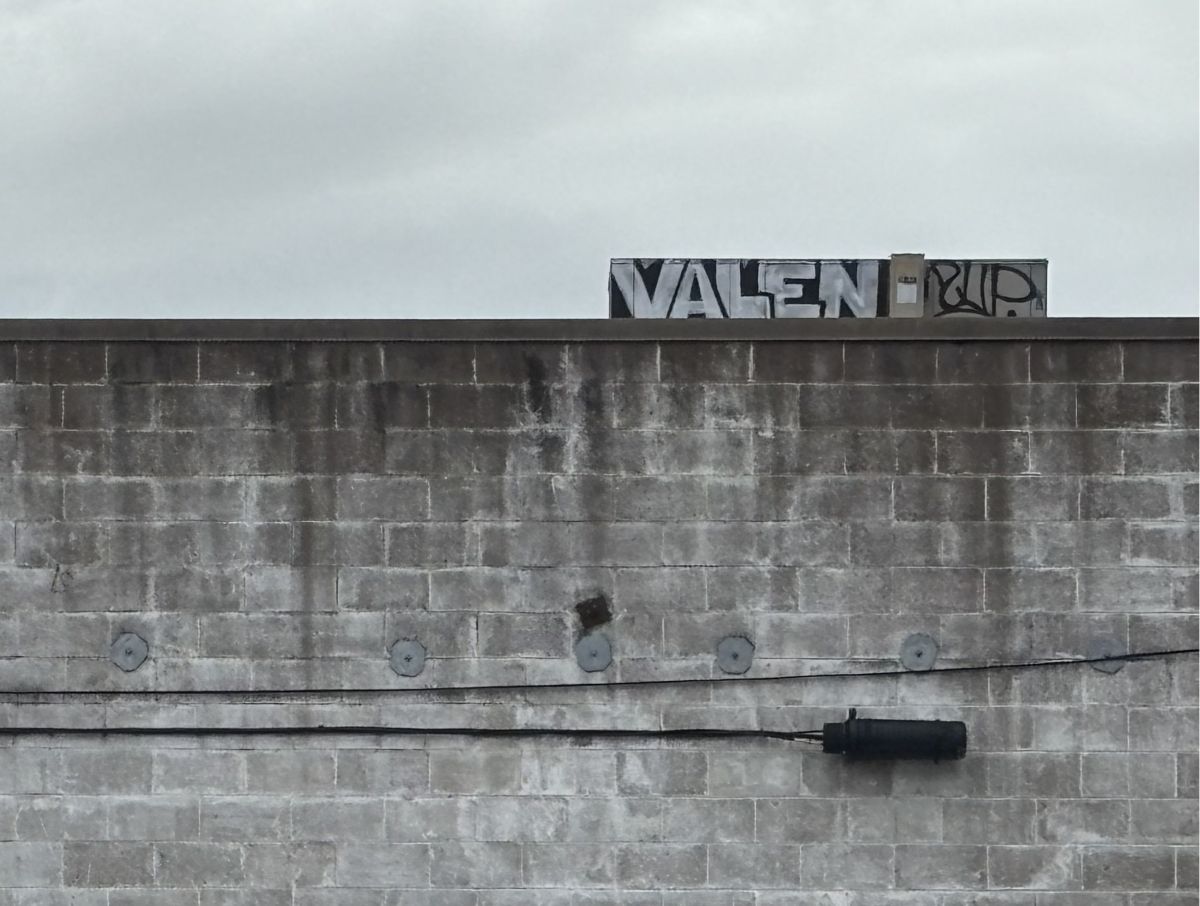
As I was passing a small, half-empty parking lot situated between two buildings, something about the place caught my attention. At the far end was a cinderblock wall that backed the alleyway. An electrical conduit ran horizontal under several braces (probably an earthquake retrofit) and just visible above that was a small structure on the roof, with a “throw” (stylized graffiti lettering) that read “VALEN.”
I wasn’t sure what was interesting about that. I took it to be an abbreviation of Van Halen, which dated it back to the late seventies or early eighties. I stood in the gravel meditating on VALEN and how close it was to the word valence. In chemistry, valence is the attractive force of electrons. In linguistics, it’s the number of noun phrases a verb can accommodate. In psychology, it’s the intrinsic attractiveness of an emotion, event or object. The general (Merriam-Webster) definition of the word valency is “the relative capacity to unite, react, or interact.”
Anyhow, I decided to get a picture of the VALEN for later reference and because it was visually interesting. As I was adjusting the zoom on my camera, a black Mercedes SUV turned into the lot. The lot was mostly empty, so I ignored it and kept fiddling with the camera. The Mercedes stopped about fifteen feet from me. Its window rolled down an a loud, flat, irritated voice said, “You are standing where I park.”
The voice had a condescending, contemptuous tone that befuddled me. People don’t usually address each other like that. I didn’t respond immediately, but turned to get a look at the face to which the voice belonged.
She was a middle-aged woman with a blond bob, wearing Ray-Ban Wayfarers. Her long, thin mouth looked like it had been set by a stone mason. Framed by the chrome trim around the window, she looked like a Robert Bechtle painting.
“What?” I asked. I instinctively wanted to give her a chance to ask me politely if I wouldn’t mind moving so that she could park.
She didn’t. As if a change in tone would have cost her twenty bucks, she repeated, this time with a little more condescension and space between each word, “You are standing where I park.”
I’ve encountered a lot of rude people in my time. Angry bosses, coworkers, lunatics and assholes of every tint and shade. But most were rude for reasons I could understand. They were wasted or hungover or insane or frustrated or had suffered setbacks or were angry at something I’d said or done. This was a different kind of rude. It was the automatic rude that issues from superiority. I instantly felt that she regarded me as beneath her, some lowlife nonesuch standing where she wanted to park. I found it offensive.
“You have no common courtesy,” I said.
She stared.
“Is that how you treat people?” I asked. “No please? No excuse me?”
“Excuse me?” she asked.
“Yeah,” I said. “Your excuse for the way you treat people.”
Her expression did not alter. She exuded the same supercilious contempt.
“Are you living in a space bubble?” I yelled.
I’m not exactly sure why I said “space bubble.” It was about as devastating as “mustard tiger.” I guess it was the first thing I could think of to describe that remote, insular, disrespectful attitude. The accusation had no effect on her, of course. Her mouth remained as level as the cinderblocks behind her car.
Wanting nothing more to do with her, I walked off, turned the nearest corner and headed home. I’d planned on a long walk. But now I couldn’t stand the people on the street. The brunch herd, loitering outside the breakfast restaurants, prattling, digesting, quietly farting. The world seemed like a mess of arbitrary egos with private requirements and public expectations, individuals adrift in their space bubbles. Humanity had lost its valency.