A gentleman hunter enters a forest on his way home. A violent storm forces him to stop and take cover. That is the first oppressive condition that Turgenev introduces in his little masterpiece, “The Lone Wolf,” a story included in A Hunter’s Sketches (published 1852).
As the gentleman cowers in darkness and torrential rain under a bush, a lightning flash reveals the figure of a large man standing in front of him, “as if he had risen out of the ground.” The man identifies himself as the forester. The gentleman identifies himself and the forester claims to know who he is. He offers to shelter the gentleman in his home. He then leads the gentleman’s horse and cart through the woods, in total darkness and torrential rains, lightning flashing and thunder booming, to a hut. There the gentleman encounters the next oppressive situation: the abject poverty in which the forester lives.
A little girl leads the gentleman into the hut, which he describes as “a single room, and a wretched room it was. It was low and smoky, and without the utensils that one usually sees in a peasant’s hut; there were neither partitions nor lofts.”
To add to the wretchedness of the cabin, he observes the girl rocking an infant in a cradle, who is “breathing painfully.” While the forester is outside putting the gentleman’s horse under the shed, the gentleman asks the girl if she is alone, to which she answers yes in “a weak, timid voice.” He asks her if she is the forester’s daughter. “Yes,” she stammers.
The forester stoops into the hut and the gentleman describes him as “a tall, broad-shouldered man, with a figure such as one seldom sees. The muscles of his chest and brawny arms stood out beneath the folds of his thick shirt, which was dripping with water.” When the gentleman asks him who he is, the forester answers that his name is Foma and that he is called “Birouk,” meaning The Wolf.
This is the next oppressive condition: Foma is a legendary forester with a reputation for vigilance, strength, ferocity and integrity. “There was no way of bribing him; neither brandy nor money had any effect on him; nothing could seduce him.”
The gentleman asks Foma if his wife has died, to which he haltingly answers in the affirmative: “She ran away with a passing bourgeois.”
Foma’s abandonment by his wife is not the end of his troubles. His children are sick and starved. He leaves again to tend to the horse, and the gentleman observes the child with whom he is now alone: “The little girl stood motionless with downcast eyes; only from time to time she pushed the cradle, timidly pulling her frock on her shoulder, her bare legs hung down at the side of her stool.”
He asks her name. “Oulita,” she says, “bending down her thin face still farther.” Oulita is the name of the Christian martyr Saint Julitta, who, with her three-year-old son Cyricus took refuge in Tarsus. When the Roman governor of Tarsus, Alexander, was angered by the boy, he threw him down the steps of the tribunal. He then had Julitta brutally tortured and decapitated. Julitta and Cyricus are patron saints of the happy family. Oulita also means “sandpiper,” which reflects her gentle and timid disposition and birdlike appearance.
As a writer, Turgenev exercises a wonderful subtlety in the scenes he describes, leaving the reader to unpack their historic and symbolic significance. In this scene, a story of violent oppression, Julitta and Cyricus, underlies his description of the girl and sick infant. And it compounds the theme of violent oppression that runs through the whole story.
Foma returns and says the storm has quieted down and offers to show the hunter out of the woods. But first he must go after someone who is chopping down a tree. The gentleman, out of curiosity, asks if he can go with Foma to apprehend the poacher. Foma agrees and they head toward the chopping sound, which at first only Foma can hear.
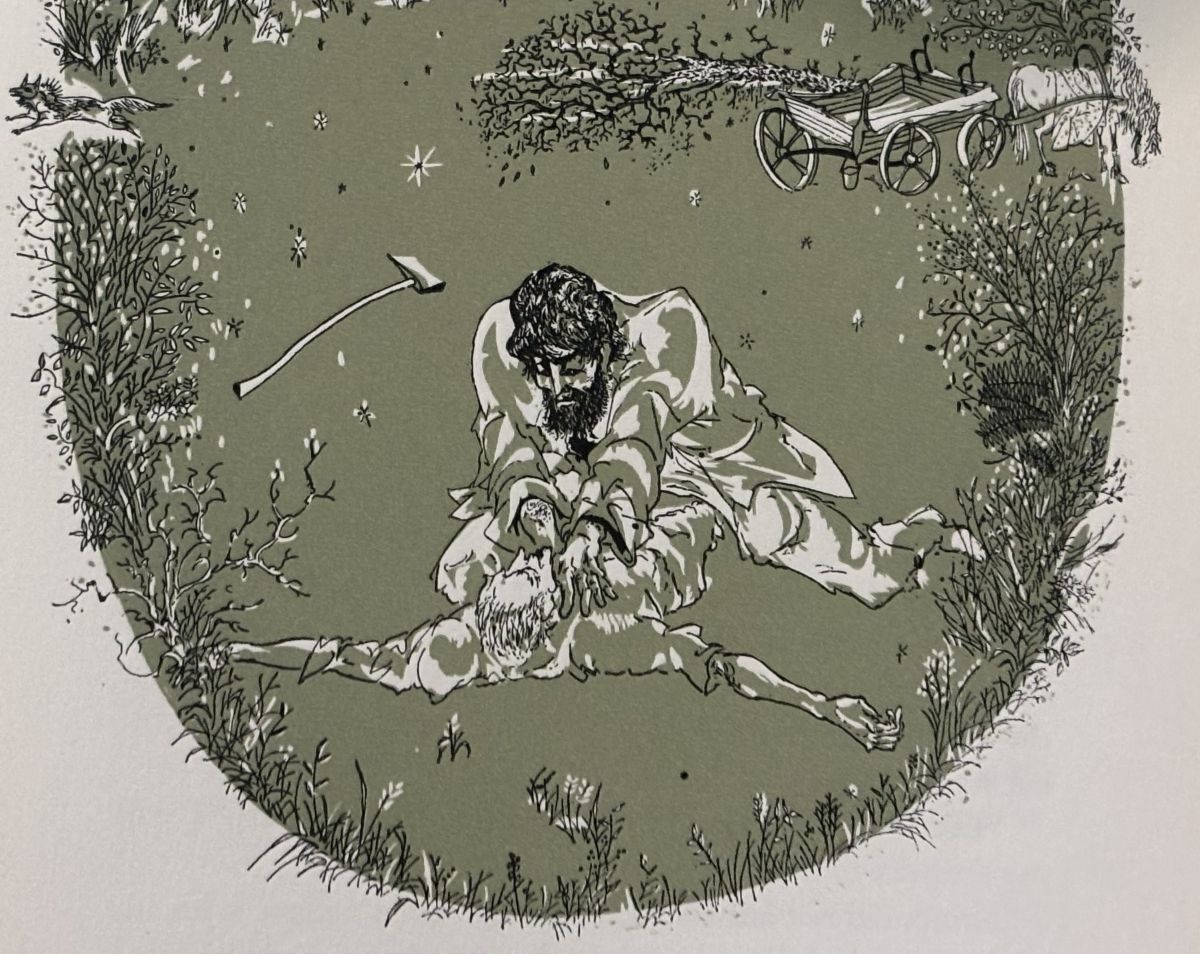
They descend into a ravine and the gentleman describes Foma pouncing on the poacher, a starving peasant in rags, and binding him. Foma transports the peasant back to his hut, where the peasant begs for his life: “Let me go, Foma Kousmitch. Do not destroy us. You know well what awaits me. The steward will devour me; indeed he will!”
As the peasant pleads, Foma’s reply is, “I have my duties to do; I must be severe with such as you.”
Seeing that Foma cannot be swayed, the peasant starts demanding that he put him to death on the spot: “I had rather have it over at once than die of hunger. Let us all perish at once—my wife, my children! As to you, never fear; we shall meet you again.”
At this, Oulita, who has been lying on the dirt floor, stands up. This is Turgenev’s signal that something unspeakable is about to happen. Oulita’s fright anticipates the murder of this peasant right there on the floor in front of her.
The peasant continues his provocation: “You are a slayer of souls, a ferocious beast! But wait; you will not reign much longer. You will be strung up by the neck, you may be sure of that!”
At this indictment and threat, Foma grabs the peasant by the shoulder. The gentleman stands up to intercede, but Foma tells him to stand back. We think for a moment that Foma will add homicide to his existing pile of woes. But he releases the belt that binds the peasant and throws him out of the cabin, yelling at him to go to the devil, along with his horse.
The gentleman hunter says, “You astonished me. You are a worthy man.”
Ashamed and angry at himself both for betraying his duty to the steward (manager of the estate) and his reputation as the hard, incorruptible Birouk, Foma tells the hunter not to talk about it. And as the peasant’s cart passes the windows of the cabin, he says, “Ah! I—” He, too, is astonished—at himself.
In the last sentence of the story, the gentleman takes leave of Foma at the edge of the woods, which completes his deliverance and the dramatic arc of the “The Lone Wolf,” which is not so much an arc as a slope. It is a concatenation of one oppressive scenario after another that leads the reader into an exploration of oppression itself.
At first, we think the appearance of Foma is fortuitous, as he will save the gentleman from the oppression of the storm. But this leads the gentleman to Foma’s home, which reveals a more dolorous and oppressive scene. We see a man of powerful animus, vigorous character and iron-clad reputation oppressed by poverty and abandonment and living like an animal. His children are starving and suffocating and his wife and helpmate has left him for a bourgeois (in Tsarist Russia a member of the professional class).
The story explores two sides of Foma: a beast who in his duty is pitiless, rigid, cruel and “strong and quick as the evil one”; and a man who, despite his destitution, is a father, generous host and good Samaritan. Behind Foma’s humanity are the symbolic evils of his reputation and the caste system of Tsarist Russia by which he earns his “master’s bread.” This contrast between the man in the present and the beast of local lore persists until the end of the story, when Foma and Birouk join in the act of apprehending the poacher.
When Foma releases the poacher, he betrays his reputation. He shows mercy and reveals his essential humanity. The gentleman calls him “a worthy man.”
What Turgenev describes in this story is a situation in which someone who suffers under an oppressive system works as an agent of the oppressor. This is not uncommon in oppressive regimes. For example, among ICE agents, 20% to 30% are Latino and come from the very communities in which they conduct their raids. It has never been uncommon for vigorous and obedient individuals to be used by the powerful to oppress their own. In the American antebellum South, trusted slaves were appointed as “drivers” to enforced discipline and punish fellow slaves. In Tsarist Russia, Foma was a man of the lowest class imaginable, a man who lived like a wild animal, yet whose exceptional constitution suited him to guard his master’s forest.
By the end of the story, the gentleman has been delivered from the forest, Foma has been delivered from his reputation as Birouk (the wolf), and the essentially gregarious and sympathetic side of him (the human) prevails. This is what the gentleman (Turgenev) finds astonishing. Yet, despite this hopeful outcome, the oppressive system remains. Not much will change for Foma or the peasant whom he liberates. The only upside is the astonishing fact that a man who is destitute and oppressed, whose livelihood depends on being a beast, can sometimes be more than a beast and give his fellow sufferers a break.